
NFL
Top Members of Congress Say Donald Trump Misled Lawmakers by Claiming Nigeria Threats Were Only Diplomatic Pressure—Then Quietly Ordered a Sokoto Airstrike Without Approval

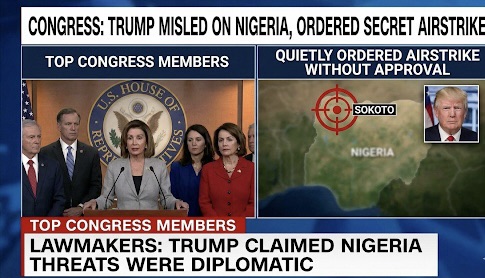
Top Members of Congress Reveal Trump Misled Lawmakers Before Secret Sokoto Airstrike
Washington, D.C. — Senior members of the U.S. Congress have revealed explosive details surrounding President Donald Trump’s controversial strike on Sokoto, Nigeria, alleging that the president deliberately misled lawmakers before ordering a surprise military action.
According to multiple Democratic leaders and several high-ranking Republicans, Trump initially briefed Congress that his aggressive rhetoric about sending U.S. troops “gun blazing” to Nigeria was purely a pressure tactic, not a real military plan. Lawmakers say they were told the threat was intended to push Nigeria into taking stronger internal security actions and to encourage deeper economic and strategic cooperation with the United States — not to justify direct U.S. military intervention.
However, congressional leaders now say those assurances were false.
Behind closed doors, and without further consultation or authorization, Trump allegedly secretly approved an airstrike on Sokoto, catching even top congressional figures off guard. Several lawmakers claim they only learned of the strike after it had already been carried out, triggering outrage across Capitol Hill.
“This was not what we were told,” a senior Democratic lawmaker said. “The president framed this as diplomatic pressure — not a covert military operation. Congress was deceived.”
What has intensified the backlash is the constitutional question at the heart of the controversy. Lawmakers argue that the strike did not meet the legal threshold of an emergency, nor was there any immediate threat to U.S. territory or citizens that would allow the president to act unilaterally.
“This was a deliberate bypass of Congress,” said a top Republican senator. “You cannot threaten diplomacy in public and then quietly authorize military force behind the scenes.”
The revelation has united an unusual coalition of Democrats and Republicans, with both sides demanding an immediate investigation, classified briefings, and a full accounting of who knew about the operation and when. Some members are calling for subpoenas, while others are discussing legislative action to restrict presidential war powers going forward.
Internationally, the strike has already strained U.S.–Nigeria relations, with critics warning that deception at the congressional level could undermine America’s credibility with allies and partners across Africa.
As pressure mounts, the White House has defended the president’s actions as “decisive leadership,” though it has not directly addressed accusations that Congress was misled.
For now, the controversy continues to grow, raising serious questions about executive power, transparency, and whether the president acted alone in one of the most unexpected foreign military actions of his administration.

Inside the Alleged Deception — How Congress Says Donald Trump Used Diplomatic Language Publicly While Planning Military Action in Nigeria secretly

Top Members of Congress Say Donald Trump Misled Lawmakers by Claiming Nigeria Threats Were Only Diplomatic Pressure—Then Quietly Ordered a Sokoto Airstrike Without Approval

Bipartisan Fury on Capitol Hill as Congress Democrats and Top Republicans Condemns Donald Trump’s Surprise Military Strike on Sokoto, Nigeria, Saying Lawmakers Were Never Consulted, Says The President Cannot Act Alone in that situation as it’s not an emergency as they demand immediate investigation and action

Taylor Swift Tears Into Donald Trump, Calling Him a “Piece of Shit” After Christmas-Day U.S. Strikes in Sokoto, Nigeria, Says “That POS Really Bombed Nigeria on Christmas Day”

Travis Kelce Hints at Possible Retirement After Emotional Night at Arrowhead Against Broncos, Saying “I’ll Forever Be a Chief, But It Might Be Time to Focus on Family and My Wedding to Taylor Swift

Arrowhead Honors Travis Kelce in What Could Be His Final Home Game as His Retirement Rumors Continue, With Taylor Swift Cheering Proudly from the Stands Against the Broncos

Auntie Swift Is Back 😎 Taylor Swift Goes Full Cool Aunt Mode, Babysits Jason Kelce’s Kids and Turns Chiefs vs. Broncos Game Into a Family Day at Arrowhead

Taylor Swift Resumes Her “Cool Auntie” Duties as She Babysits Jason Kelce’s Kids and Brings Them to Arrowhead for Chiefs vs. Broncos to support Travis Kelce

Taylor Swift Makes Festive Arrival at Arrowhead Stadium in Signature Red Leather Jacket to Cheer on Fiancé Travis Kelce in Chiefs’ High-Stakes Christmas Day Clash with Broncos

Travis Kelce Brings Girlfriend Taylor Swift Home for the Holidays: Couple Spotted Enjoying a Traditional Christmas at Grandma’s Cozy Residence

End of an Era at Arrowhead: Travis Kelce Arrives With Taylor Swift for His Final Arrowhead Appearance Game as a Kansas City Chief Against the Broncos on Christmas Eve as Retirement Rumors Intensifies
