
NEWS
Congress Set to Pass Sweeping Legislation Mandating Automatic Refunds After Supreme Court Declares Donald Trump Tariffs Illegal

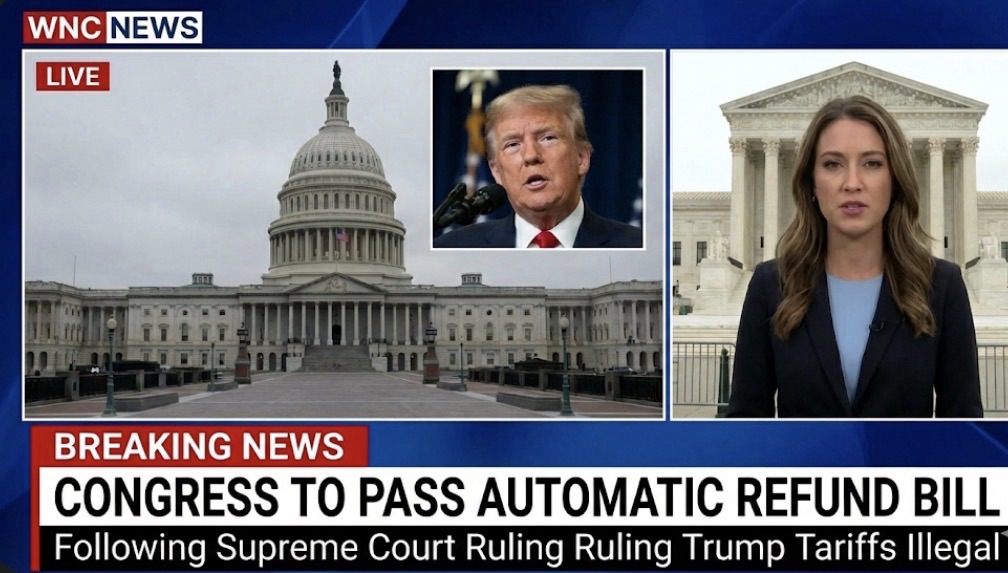
Congress Moves to Mandate Automatic Refunds After Supreme Court Strikes Down Trump Tariffs
Washington, D.C. — Congress is advancing sweeping legislation that would require automatic refunds for billions of dollars collected under tariffs imposed by Trump after SCOTUS ruled the measures unlawful.
The proposed bill, which has gained momentum in both chambers, would direct the Treasury Department to immediately calculate and return funds collected from businesses and importers under the invalidated tariff program. Lawmakers backing the legislation say the refunds must be automatic, arguing that companies should not be forced to navigate lengthy claims processes to recover money paid under a policy now deemed illegal.
The Supreme Court’s decision concluded that the former president did not have the authority under the emergency powers statute cited to impose the sweeping tariffs. The ruling effectively nullified the tariff program and opened the door to legal and financial consequences for the federal government.
In response, congressional leaders moved quickly to prevent further uncertainty. Supporters of the refund bill say it is designed to provide clarity, restore confidence in U.S. trade policy, and protect businesses that absorbed significant costs over the duration of the tariff enforcement.
Several major retailers and manufacturers have indicated that the tariffs disrupted supply chains and raised consumer prices. Economists estimate that billions of dollars were collected during the period the tariffs were in effect. If passed, the legislation would require the Treasury to issue payments directly to affected entities within a defined timeline, with oversight mechanisms to ensure transparency.
Critics of the measure argue that the refund process could strain federal finances and create administrative challenges. However, proponents counter that compliance with the Supreme Court’s ruling is not optional and that swift reimbursement is necessary to uphold the rule of law.
The bill is expected to face debate over implementation details, including how to verify eligible claims and whether interest should be included in refunded amounts. Despite those questions, bipartisan pressure appears to be building to resolve the issue quickly.
If enacted, the refund mandate would mark one of the most significant congressional responses to a Supreme Court ruling on executive trade authority in recent history, potentially reshaping how future administrations approach tariff policy.

Congress Set to Establish Special Procedures and Strict Deadlines for Tariff Refund Claims After Donald Trump Tariffs Ruled Illegal by Supreme Court of the United States

Congress Set to Pass Sweeping Legislation Mandating Automatic Refunds After Supreme Court Declares Donald Trump Tariffs Illegal
Supreme Court of the United States Issues Arrest Warning for any Treasury Officials Who Enforce ‘Illegal’ Tariff Duties after Donald Trump Vows Tariffs Will Continue despite the court ruling Tariff illegal

Amazon CEO Jeff Bezos Confirms Company Plans to Recover $35 Billion Following Supreme Court Decision That Struck Down Donald Trump’s Controversial Tariffs

Retail Giant Walmart Demands $28 Billion Refund After Supreme Court Declares Donald Trump’s Tariffs Illegal,

Supreme Court of the United States Issues Stark Warning to Donald Trump and Signal Consequences After President Signs 10% “Global Tariff” Order Despite 6–3 Ruling Limiting Emergency Powers Authority

Donald Trump Insists His Tariffs Will Remain in Effect Despite Supreme Court Ruling Declaring the Tariffs not Effective and Trade Measures Illegal

Taylor Swift Publicly Calls Donald Trump ‘Unfit for Office,’ Accuses Him of ‘Destroying the Country’ in Blunt Political Statement

U.S. Senators Formally Invoke 25th Amendment, Call for President Donald Trump’s Removal from Office

Disabled American Veterans (DAV) File Federal Lawsuit Against Donald Trump After Proposal to Slash SSI and Veterans Benefits to Reallocate Funds to United States Department of Homeland Security Amid Shutdown

Stephen Colbert Launches $750 Million Federal Lawsuit Against FCC and Donald Trump in Punitive and Compensatory Damages , Accusing Trump of Orchestrating Brazen Censorship and a Direct Assault on Press Freedom and Free Speech by Forcing CBS to Pull Interview with Texas Senate Hopeful James Talarico
