
NEWS
US Lawmakers Seek to Reclaim Authority Over War Decisions, Introducing New Resolution to Require Donald Trump to Obtain Congressional Approval Before Military Action After Strikes Against Iran and recent strike in Venezuela

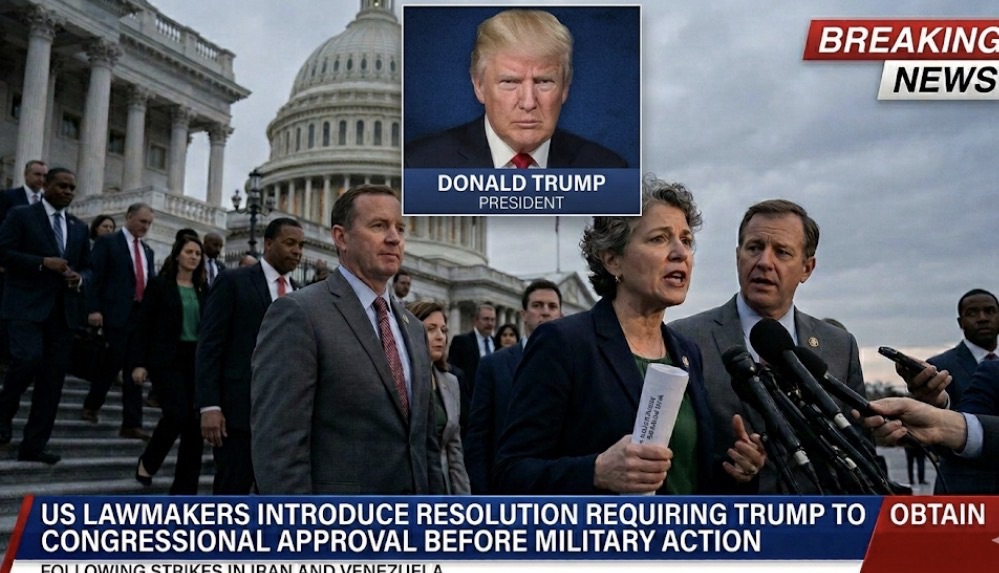
Congress Moves to Limit Trump’s Ability to Conduct Military Strikes on Iran
Washington, D.C. – U.S. lawmakers are moving to assert their constitutional authority over military action as tensions with Iran continue to rise. A new War Powers Resolution is being advanced in both the House of Representatives and the Senate, aimed at restricting President Donald Trump from launching unilateral military strikes without explicit Congressional approval.
Under the 1973 War Powers Resolution, the President is required to notify Congress within 48 hours of committing U.S. forces to combat and must end military action within 60–90 days unless Congress authorizes further action. Lawmakers say the resolution is necessary to prevent the President from engaging in prolonged or escalatory conflicts without oversight.
Leading the push are Senators Tim Kaine (D‑Va.), Chuck Schumer (D‑N.Y.), and Representative Ro Khanna (D‑Calif.), alongside bipartisan support from lawmakers like Rep. Thomas Massie (R‑Ky.). The resolution does not impede legitimate self-defense actions but would require Trump to come to Congress for approval before authorizing offensive strikes against Iran.
“Congress has the constitutional responsibility to declare war,” said Rep. Khanna. “We cannot allow the President to unilaterally drag the country into conflict in the Middle East.”
The resolution comes amid growing concerns over reports of military buildup in the region and potential confrontations with Iranian forces. Supporters argue that requiring congressional approval would ensure accountability and prevent rash military decisions that could escalate into a larger conflict.
However, the effort faces stiff opposition. Many Republicans, particularly in the Senate, argue that limiting the President’s authority could undermine the nation’s ability to respond swiftly to threats abroad. Previous attempts to pass similar measures have failed, with lawmakers citing concerns over executive flexibility in national security matters.
Political analysts say the resolution is as much about reasserting Congress’s constitutional role as it is about controlling Trump’s foreign policy decisions. While passage in both chambers may be unlikely, the debate underscores the ongoing tension between executive power and legislative oversight in matters of war.
As Washington prepares for the vote, all eyes are on how Congress will balance national security needs with constitutional checks on presidential authority—and whether Trump will heed the resolution or challenge it in court.

Bipartisan War Powers Resolution Aims to Reassert Congressional Authority Over Military Action, Challenging Donald Trump’s Plans for Strikes in the Middle East after U.S.- Israel Attacks Iran

US Lawmakers Seek to Reclaim Authority Over War Decisions, Introducing New Resolution to Require Donald Trump to Obtain Congressional Approval Before Military Action After Strikes Against Iran and recent strike in Venezuela

China Set to Deploy 5,000 Troops to Iran Alongside 200 Advanced Missiles, Drones, Multiple Air Defense Systems, and Anti‑Ship Weapons, Escalating Tensions After U.S. and Israel Strike Led by Donald Trump and Benjamin Netanyahu

United Nations Strongly Condemns U.S.–Israel Strikes on Iran, threatens sanctions on Donald Trump and Benjamin Netanyahu, Calls for Immediate Ceasefire and Urgent Diplomatic Talks to Prevent Regional War

Russia Announces Immediate Deployment of 50 Fighter Jets and 20,000 Troops to Support Iran After U.S.–Israel Strike led by Donald Trump and Benjamin Netanyahu

Russia Strongly Condemns Recent U.S and Israel Strikes on Iran lead by Donald Trump and Benjamin Netanyahu on Iran as an “Unprovoked Act of Armed Aggression,” Declares It Stands Firmly and Solidly With Iran Amid Rising Tensions

Supreme Court Rejects Broad Immunity Claims and Orders Donald Trump to Provide Testimony in Expanding Jeffrey Epstein Proceedings

House Democrats Secure Enough Votes to Compel Donald Trump to Testify Under Oath About His Alleged Relationship With Jeffrey Epstein

U.S. Supreme Court Rules Donald Trump Does Not Have Full Immunity, Faces Subpoena in Epstein Case Following Bill Clinton Testimony

Private Messages Between Donald Trump and Bill Clinton Surface Ahead of Epstein Testimony

Donald Trump Declares SAVE Act Will Be Implemented “With or Without” Senate Approval, Vows Executive Action if Necessary
