
NEWS
After the Supreme Court of the United States Rules That Donald Trump’s Tariffs Are Illegal, the U.S. Treasury Reveals It Has Received Only Roughly About 30% of the Projected $133 Billion in Revenue, Leaving Billions Unaccounted For and Raising Questions About Fiscal Oversight

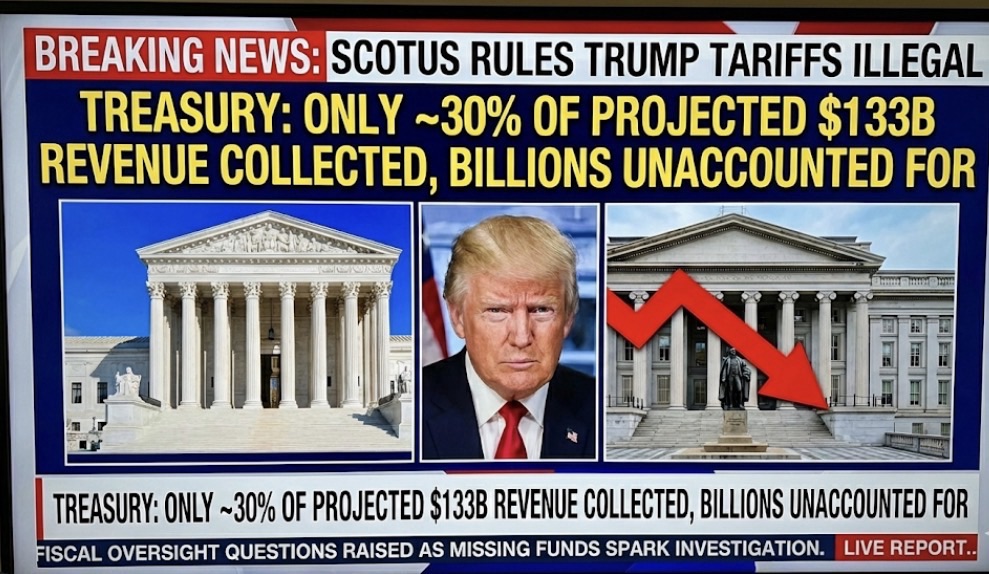
Treasury Reveals Massive Shortfall in Tariff Revenue Following Supreme Court Ruling Against Trump
Washington, D.C. – In the aftermath of the SCOTUS striking down Donald Trump’s sweeping tariffs as illegal, the U.S. Treasury has disclosed that it has accounted for only roughly 30% of the estimated $133 billion in tariff revenue. The revelation leaves billions of dollars uncollected or unaccounted for, raising urgent questions about federal fiscal oversight and enforcement.
The tariffs, which were imposed over the past several years on a broad range of imported goods, were challenged in court by multiple companies and trade associations. The Supreme Court’s decision declared that the President did not have the legal authority under the cited emergency powers law to levy such sweeping tariffs.
Treasury officials confirmed that of the projected $133 billion, only about $40 billion has been received and properly recorded. The remaining approximately $90 billion remains “unaccounted for,” according to the agency, prompting concerns among lawmakers, trade experts, and budget analysts over how such a significant sum could be missing.
“This is unprecedented,” said a senior Treasury official, speaking on condition of anonymity. “Not only does this ruling invalidate the tariffs themselves, but it also exposes significant gaps in the way these funds were collected and tracked.”
The shortfall comes as the federal government is already under pressure to reconcile budget allocations and manage trade enforcement. Lawmakers from both parties have expressed alarm, calling for immediate investigations into Treasury operations and potential audit procedures to ensure the missing funds are traced and accounted for.
Experts warn that the missing revenue could have implications for U.S. trade policy, government spending, and ongoing international negotiations. Companies affected by the tariffs, including major retailers and manufacturers, may also seek refunds or compensation, further complicating the financial landscape.
“The Supreme Court ruling and the Treasury’s disclosure together represent a perfect storm for federal finance,” said a trade policy analyst. “It highlights not only the legal limits of executive power but also systemic weaknesses in revenue tracking that must be addressed immediately.”
Treasury officials say they are working to reconcile records and identify the sources of the missing funds, but no timeline has been given for when a full accounting will be completed. Meanwhile, the fallout from the Supreme Court’s decision continues to reverberate across Washington, with both political and business leaders closely monitoring the situation.

United States men’s national ice hockey team who win Gold at Olympic Declines Donald Trump’s Invitation to Attend his State of the Union Address, as they states reason why

After the Supreme Court of the United States Rules That Donald Trump’s Tariffs Are Illegal, the U.S. Treasury Reveals It Has Received Only Roughly About 30% of the Projected $133 Billion in Revenue, Leaving Billions Unaccounted For and Raising Questions About Fiscal Oversight

Congress Set to Establish Special Procedures and Strict Deadlines for Tariff Refund Claims After Donald Trump Tariffs Ruled Illegal by Supreme Court of the United States

Congress Set to Pass Sweeping Legislation Mandating Automatic Refunds After Supreme Court Declares Donald Trump Tariffs Illegal
Supreme Court of the United States Issues Arrest Warning for any Treasury Officials Who Enforce ‘Illegal’ Tariff Duties after Donald Trump Vows Tariffs Will Continue despite the court ruling Tariff illegal

Amazon CEO Jeff Bezos Confirms Company Plans to Recover $35 Billion Following Supreme Court Decision That Struck Down Donald Trump’s Controversial Tariffs

Retail Giant Walmart Demands $28 Billion Refund After Supreme Court Declares Donald Trump’s Tariffs Illegal,

Supreme Court of the United States Issues Stark Warning to Donald Trump and Signal Consequences After President Signs 10% “Global Tariff” Order Despite 6–3 Ruling Limiting Emergency Powers Authority

Donald Trump Insists His Tariffs Will Remain in Effect Despite Supreme Court Ruling Declaring the Tariffs not Effective and Trade Measures Illegal

Taylor Swift Publicly Calls Donald Trump ‘Unfit for Office,’ Accuses Him of ‘Destroying the Country’ in Blunt Political Statement

U.S. Senators Formally Invoke 25th Amendment, Call for President Donald Trump’s Removal from Office
