
NFL
Donald Trump Vows to Immediately Move ICE Agents to Every U.S. Airport for Security Like No One Has Ever Seen Before, Promising Immediate Arrest of All Illegal Immigrants IF Democrats don’t Sign Agreement to Make U.S. Airports Free and Safe by Reopening TSA

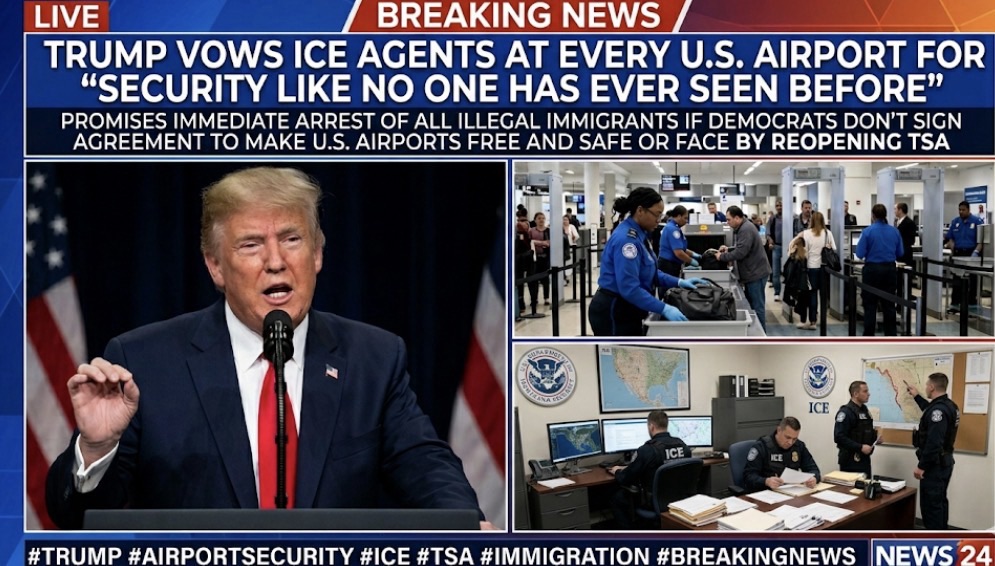
President Donald Trump has issued a bold ultimatum amid an ongoing funding impasse at the Department of Homeland Security (DHS) that has left the Transportation Security Administration (TSA) severely underfunded, resulting in widespread airport delays, staffing shortages, and growing traveler frustration across the United States.
In a statement captured in a viral video clip shared by conservative commentator Nick Sortor on X (formerly Twitter) on March 21, 2026, President Trump declared that if congressional Democrats do not immediately agree to reopen and fully fund the TSA, he will direct Immigration and Customs Enforcement (ICE) agents to assume security responsibilities at airports nationwide.
“They will do Security like no one has ever seen before, including the immediate arrest of all Illegal Immigrants who have come into our Country, with heavy emphasis on those from Somalia,” Trump stated in the clip. He repeated the phrase for emphasis and tied the proposal to broader immigration enforcement goals, framing it as a solution to restore “free and safe” air travel.
The comment quickly ignited reactions online, with supporters hailing it as a decisive “checkmate” against Democrats, while critics raised concerns about feasibility, potential profiling, and the practicality of shifting roles between agencies.
Background on the DHS Funding Stalemate
The current crisis stems from a prolonged partial shutdown of DHS components, now stretching into weeks or more by mid-March 2026. Democrats in Congress have repeatedly blocked or withheld support for comprehensive funding bills, demanding reforms and accountability measures related to immigration enforcement operations conducted by ICE and Customs and Border Protection (CBP). These include oversight of alleged civil rights issues, limits on certain enforcement tactics, and addressing high-profile incidents.
Republicans, backed by the White House, have rejected these conditions, insisting on full funding for the entire department without what they call “poison pill” amendments. Multiple attempts to pass narrower bills—funding TSA, the Coast Guard, FEMA, and other non-enforcement agencies while excluding ICE and CBP—have failed, with both sides accusing the other of holding essential services hostage.
Travelers are bearing the brunt: long security lines, flight delays, and reports of TSA agents working without pay have created chaos at major hubs. Senate leaders from both parties, including Minority Leader Chuck Schumer and Majority Whip John Barrasso, have traded blame publicly, but negotiations with the administration have yielded little progress.
Trump’s ICE Proposal: Details and Implications
Trump’s suggestion would involve surging ICE personnel—trained primarily in immigration enforcement and investigations—into airport terminals to perform or supplement traditional TSA screening and security duties. He described the move as delivering “security like no one has ever seen before” and explicitly linked it to on-the-spot arrests of undocumented immigrants.
The repeated mention of a “heavy emphasis on those from Somalia” aligns with prior administration actions and rhetoric. Since early in Trump’s second term, the White House and DHS (under Secretary Kristi Noem) have targeted Temporary Protected Status (TPS) designations for Somalis, ending protections for thousands and directing ICE operations toward Somali communities, particularly in Minnesota’s Twin Cities area. High-profile enforcement actions, public statements labeling parts of the Somali diaspora critically, and reports of focused arrests have marked this focus.
Critics, including some immigration advocates and commentators on X, pointed out logistical hurdles: most international arrivals at U.S. airports enter legally (via visas or visa-waiver programs) and violations typically involve overstays rather than immediate unlawful entry at the gate. Redirecting ICE agents would require retraining, raise questions about racial or nationality-based profiling, and potentially disrupt already strained airport operations.
Supporters, however, celebrated the idea as a creative way to pressure Democrats while advancing mass deportation priorities. Posts on X described it as “epic,” “ICE ICE Baby,” and a necessary escalation to restore order.
Broader Context and Reactions
The proposal arrives against the backdrop of the administration’s aggressive immigration agenda, including expanded deportations, termination of various humanitarian parole programs, and efforts to reshape DHS priorities. TSA has introduced traveler-friendly changes like expanded “Shoes On” policies, but staffing crises threaten to undermine gains.
As the shutdown persists, pressure mounts on lawmakers to break the deadlock. Whether Trump’s ICE-at-airports threat forces movement—or escalates partisan tensions further—remains to be seen. For now, millions of travelers face uncertainty at checkpoints, while the political fight over funding, enforcement, and security plays out in Washington and online.

Donald Trump Vows to Immediately Move ICE Agents to Every U.S. Airport for Security Like No One Has Ever Seen Before, Promising Immediate Arrest of All Illegal Immigrants IF Democrats don’t Sign Agreement to Make U.S. Airports Free and Safe by Reopening TSA

Donald Trump Reveals Pentagon Considering Major Troop Surge to Middle East, Signals Possible Nuclear Response if War Escalates Further

Donna Kelce Marries Boyfriend Adam Scott in Elegant wedding Ceremony as Sons Travis Kelce and Jason Kelce Share Emotional Family Moment, Ex Husband Ed Kelce and Taylor Swift absent

International Criminal Court Issue Arrest Warrants for Donald Trump, Benjamin Netanyahu, and Pete Hegseth Following Their Failure to Respond to Multiple Summonses on War Crime Allegations, Possible Genocide and Crime against Humanity Linked to the Escalating Iran Conflict

Donald Trump Confirms Iran WIll Definitely Face Nuclear Response After they Shot Down a U.S. Aircraft Carrier Becoming the First Nation in History to ever do so Amid Escalating U.S.-Israel War

Iran Announces Destruction of U.S. Aircraft Carrier in Persian Gulf, Becoming the First ever country to do so as War With U.S. and Israel led by Donald Trump and Benjamin Netanyahu Reaches Dangerous New Phase

Benjamin Netanyahu Defies Donald Trump, Declares Israel Will Not Halt Strikes on Iran’s Gas Fields Despite Direct U.S. Pressure to De-escalate Conflict following Iran’s attack on Gulf Energy Site

China President Xi Jinping announced Donald Trump’s Beijing Visit Called Off as China Resists U.S. Push to Secure Strait of Hormuz Over Oil Route Dispute and Escalating Tension with Iran

North Korea Supreme Leader Kim Jong Un Calls Donald Trump “Mentally Unstable,” Describes Him as “An Old American Man With Dementia” Amid Middle East Rising Tensions with Iran and Troubles on the Strait of Hormuz

Congress Intelligence Committee Launches Sweeping Investigation Into Donald Trump Over Alleged War Crimes, Possible Crimes Against Humanity After Intelligence Failures Following Deadly Iran Airstrike That Destroyed Girls’ School in Minab Killing 100

Director of National Intelligence Tulsi Gabbard Set to be Grilled by Senate Intelligence Committee on U.S. Handling of Iran War and Intelligence Failures Behind Deadly Airstrike Ordered by Donald Trump That Destroyed Girls’ School in Minab, Killing Over 100 Children
