
NFL
EU Announces Plan to Exclude United States From ETIAS Authorization in Direct Response to Donald Trump’s Threatened Tariffs Against European Nations Opposing U.S. Annexation of Greenland

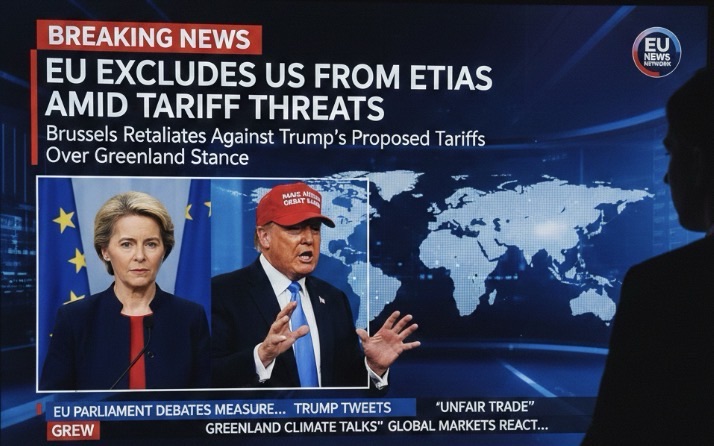
Brussels — Diplomatic tensions between Washington and Brussels escalated sharply this week after the European Union revealed a proposal to exclude the United States from the ETIAS digital travel authorization system, citing U.S. President Donald Trump’s latest threat to impose sweeping tariffs on European countries that oppose the United States’ planned annexation of Greenland.
The ETIAS system, set to become mandatory for most non-EU visitors in the coming years, allows eligible travelers to enter the Schengen Area without a traditional visa after completing an online security authorization. Until now, U.S. citizens were expected to remain among the nationalities eligible for streamlined ETIAS approvals. That assumption has now been thrown into uncertainty.
According to senior EU officials present during closed-door deliberations in Brussels, the European Commission has been drafting a policy package outlining “travel reciprocity measures” that could suspend or fully terminate American access to ETIAS. One official described the move as “a proportional response to escalating economic and territorial aggression” from Washington.
The dispute centers on President Trump’s public statement earlier this week declaring his intention to impose new tariff barriers on “all European nations working against America’s strategic acquisition of Greenland.” Several major EU members—including France, Germany, Denmark, and Italy—condemned the threat, arguing that it violates international norms and undermines European territorial integrity.
Denmark, which administratively controls Greenland, has rejected the notion of U.S. annexation outright, calling it “legally void and geopolitically reckless.” European leaders broadly agreed, offering public support for Copenhagen while warning of unpredictable consequences if Washington proceeds with unilateral pressure.
Trump’s comments, delivered via an unscheduled press briefing, called EU governments “obstructionist” and promised “strong economic retaliation” if European leaders continue to oppose U.S. strategic interests in the Arctic. Markets responded immediately, with European equities dipping and analysts warning that the rhetoric could trigger a sustained trade confrontation.
EU spokesperson Elise Maillard stated that while Europe did not seek a confrontation, it would not “sit idle as a partner attempts to coerce European foreign policy through tariffs and territorial bargaining.” Maillard emphasized that travel access, economic cooperation, and digital border authorizations were “policy areas Europe can adjust swiftly and decisively.”
In Washington, officials close to the administration dismissed the EU’s ETIAS threat as “political theater,” arguing that the United States remains one of Europe’s largest tourism drivers and that Brussels would ultimately damage its own travel industry by restricting American arrivals.
Travel industry groups across Europe have expressed concern about collateral impact. Airlines for Europe (A4E) released a statement warning that removing U.S. ETIAS eligibility could cause “administrative bottlenecks and revenue shocks,” particularly for airlines serving major routes between the United States and EU hubs such as Paris, Madrid, Lisbon, and Frankfurt.
Despite heated rhetoric, EU officials stressed that the ETIAS proposal remains in draft form, requiring approval from both the European Parliament and the Council of the EU. Analysts say the proposal is unlikely to advance without broader political consensus, though the speed at which it entered formal discussion underscores the seriousness of Europe’s response.
For now, the standoff adds a new flashpoint to already-strained transatlantic relations, joining ongoing disagreements over military coordination, energy security, and Arctic policy. Whether the ETIAS proposal becomes law may ultimately depend on how aggressively Washington pursues tariff measures—and whether European leaders believe stronger retaliation is necessary to deter U.S. pressure in the future.

Taylor Swift Accuses Donald Trump of Working so Hard to Fracture U.S.–European Alliance and NATO Relationship, Calls on Supreme Court and Congress to Act Before Irreversible Damage Occurs

Donald Trump Reveals He Hasn’t Had a Single Minute of Rest Since Taking Office After Fresh EU Sanctions against him, States He Spends Every Moment Either Ending Wars or Dealing with ‘Stubborn’ Citizens and Working to Make American Great Again, Claims Bad Americans Hate Him as He States why

EU Announces Plan to Exclude United States From ETIAS Authorization in Direct Response to Donald Trump’s Threatened Tariffs Against European Nations Opposing U.S. Annexation of Greenland

European Union Announces Full Suspension of Visa-Free Travel for All U.S. Citizens and Federal Officials, to Take Effect February 1, Immediately Following Donald Trump’s Tariff Declarations Against European Nations Opposing U.S. Plans to Seize Control of Greenland

EU Court and European Commission Announce Coordinated Decision to Impose Visa Restrictions and Sanctions on U.S. Citizens and Government Officials Following Donald Trump’s Threat of Tariffs Against European Countries Opposing Greenland Annexation

The Department of Justice is investigating Minnesota officials and Donald Trump Order to invoke the Insurrection Act due to ongoing unrest after ICE agents were Attacked

U.S.–EU And NATO Tensions Spike as Donald Trump Floats Tariffs for Opposing Greenland Plans as The President Issues Ultimatum to Opposing Countries

Supreme Court Restricts ICE Tactics in Minnesota Following Multiple Killings, Ordering Agents to Halt Aggressive Arrests and Crowd Control Amid Rising Public Outcry despite Donald Trump’s Insurrection Act Threat

President Trump Signs Controversial Executive Order to Withdraw All Federal Assets From Minnesota, Declares ‘Let Minnesota Burn’ as Armed Anti-ICE Group Reportedly Assaults Federal Agents Outside Minneapolis Federal Building

Taylor Swift blames Donald Trump for disrupting America and for the ongoing unrest in Minnesota, where violent anti-ICE protests have broken out.

Donald Trump Accuses Minnesota Leaders of ‘Harboring Anti-Federal Militants,’ Signs Executive Order Removing Agencies and Resources From the State After Anti-ICE Assault on Federal Officers”
