
NFL
House of Representatives Narrowly Passes Sweeping DHS Funding Bill 220–207, Authorizing a $10 Billion Increase in ICE Operational Funding Through Fiscal Year 2026 With Six Democrats Crossing Party Lines after Donald Trump’s involvement

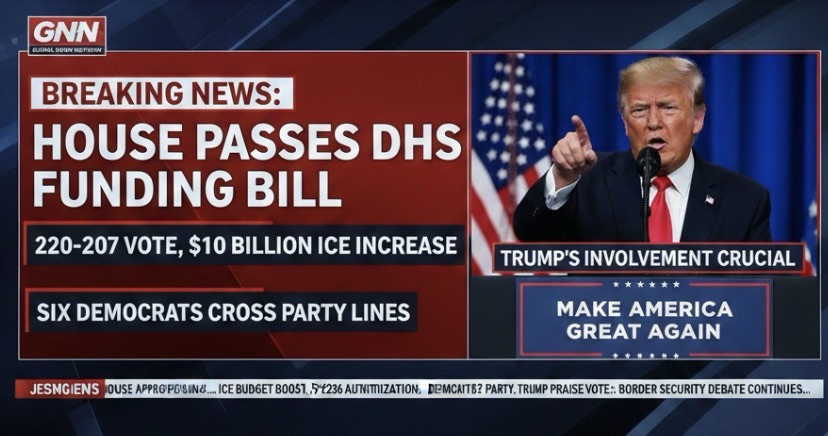
The House of Representatives has approved a new Department of Homeland Security (DHS) funding bill that significantly expands the budget for U.S. Immigration and Customs Enforcement (ICE), passing in a 220–207 vote after a contentious floor debate. The measure allocates an additional $10 billion for ICE operations through fiscal year 2026, positioning the agency for one of its largest operational budget increases in recent years.
Key Provisions and Funding Details
Under the bill, ICE would receive increased resources for enforcement operations, detention capacity, transportation, technology, and administrative support. Supporters of the legislation argue that the expanded budget is intended to address rising caseloads, improve logistical infrastructure, and enhance federal coordination on immigration enforcement.
The funding is part of a broader DHS appropriations package that also includes allocations for border security infrastructure, Customs and Border Protection (CBP), cybersecurity programs, and federal emergency management initiatives.
Bipartisan Dynamics During the Vote
While the majority of Democratic lawmakers opposed the bill, six Democrats broke ranks and joined House Republicans to advance the legislation:
Henry Cuellar (TX) Marie Gluesenkamp Perez (WA) Gillen (NY) Tom Suozzi (NY) Jared Golden (ME) Don Davis (NC)
Their support provided a narrow but sufficient margin for passage, highlighting policy divisions within the Democratic caucus over immigration enforcement and DHS spending priorities.
Reactions and Policy Debate
Republican supporters framed the bill as necessary for national security and immigration system management, pointing to increased encounters at the southern border and ongoing backlogs in processing and detention systems. Several GOP members argued that a larger ICE budget would enable the federal government to enforce existing laws more effectively and alleviate pressure on state and local jurisdictions.
Democratic opponents criticized the funding increase as an expansion of enforcement-centered immigration strategy rather than one focused on humanitarian processing, legal pathways, or immigration court reform. Some lawmakers expressed concern about detention conditions, the growth of enforcement contracts, and what they describe as insufficient oversight of ICE spending.
Legislative Path Forward
With House passage secured, the bill now moves to the Senate, where the funding levels for ICE are expected to face additional scrutiny. Senate appropriators may propose amendments, negotiate funding caps, or revise enforcement provisions as part of broader DHS budget negotiations.
The outcome will depend on cross-party negotiations, White House priorities, and ongoing national debates over immigration, border security, and humanitarian policy.
Context and Outlook
The vote arrives amid heightened attention on immigration policy, with both political parties preparing for the upcoming budget cycle and positioning themselves for future electoral debates. The proposed funding increase illustrates how immigration enforcement remains a central — and often divisive — component of federal budgeting.
If the Senate ultimately adopts similar funding levels, ICE would enter fiscal year 2026 with substantially expanded financial resources, reshaping its operational capacity well into the mid-2020s.

House of Representatives Narrowly Passes Sweeping DHS Funding Bill 220–207, Authorizing a $10 Billion Increase in ICE Operational Funding Through Fiscal Year 2026 With Six Democrats Crossing Party Lines after Donald Trump’s involvement

NATO Diplomats Reportedly Drafting Invitation Proposal for Russia After Years of Russia’s Application Rejections, Citing Donald Trump’s NATO Threats, Greenland Ambitions and Aggressive Tariff Threats as Drivers of a New Strategic Calculus

House Rules Committee Set to Debate Controversial Donald Trump and Republican DHS and ICE Funding Bill, Drawing Sharp Criticism From Democrats Who Warn That Increased Enforcement Spending Could Escalate Immigration Crackdowns Without Oversight

Taylor Swift Publicly Condemns Donald Trump’s Support for ICE Enforcement After Reports of Illegal Arrests and Deaths, Declaring ‘We Are Not the Enemy, We Are Americans’ as She Urges Compassion and Accountability

Russia President Vladimir Putin and China’s President Xi Jinping Set Conditions Before Accepting Donald Trump’s U.S. Led Gaza Peace Board Invitation

Taylor Swift to Become the Youngest Artist Ever Inducted Into the Songwriters Hall of Fame as Organization Officially Confirms June 11 Ceremony

Taylor Swift will officially be inducted into the Songwriters Hall of Fame on June 11 !

Air Force One Forced to Turn Around Mid-Atlantic on its way to World Economic Forum in Switzerland After Takeoff After Intelligence Reports Surface That an International Arrest Warrant Has Been Issued for President Donald Trump, Prompting Emergency Consultations with White House Legal and Diplomatic Teams

Supreme Court Rejects Donald Trump’s Attempt to Mandate Voter ID Nationwide, Reinforcing That the Constitution Grants Election Regulation Powers Solely to Congress and the States, Not the President

Supreme Court Blocks Donald Trump’s Controversial Attempt to Require Voter ID for Every Single Vote, Rejecting His “No Exceptions” Rule as Unconstitutional

National Children’s Alliance Sues ICE for $150 Million Over Alleged Child Endangerment After Father’s Arrest Leaves 6-Year-Old Alone in Home; Organization Also Seeks $50 Million from Donald Trump for Backing the Unlawful ICE Operations
