
NEWS
U.S. House and Senate Secure the Necessary Votes to Pass the Bipartisan NATO Unity Protection Act, Explicitly Blocking Donald Trump From Using Military Force to Seize Greenland, a Danish Territory Under NATO Protection

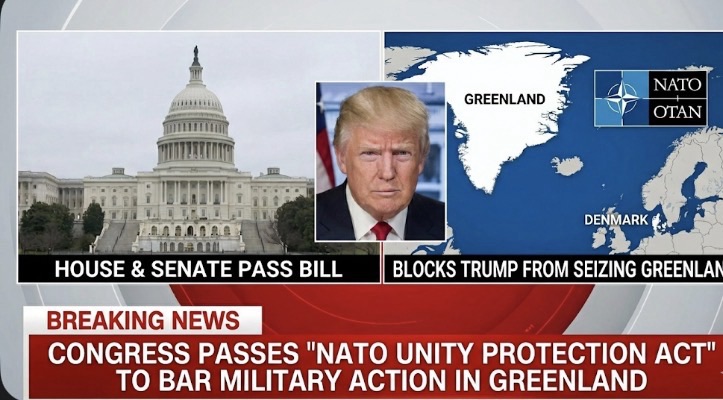
U.S. House and Senate Move to Pass Bipartisan NATO Unity Protection Act, Averting Potential Military Action on Greenland
WASHINGTON, D.C. — In a rare moment of broad congressional consensus, both the U.S. House of Representatives and Senate have secured the necessary votes to advance the NATO Unity Protection Act, a bipartisan measure designed to explicitly block any future presidential use of military force to seize sovereign territory of a NATO member — most notably, Greenland, the vast Arctic island that is part of the Kingdom of Denmark.
The legislation comes amid heightened tensions triggered by repeated statements from President Donald Trump suggesting that the United States should pursue control of Greenland for national security purposes, including refusing to rule out military options and reportedly seeking expanded military access.
🧭 What the NATO Unity Protection Act Would Do
At its core, the NATO Unity Protection Act would:
Prohibit the use of federal funds from the Department of Defense or the State Department to blockade, occupy, annex, or otherwise assert control over the territory of any NATO member state without that ally’s consent. Affirm U.S. commitments to NATO unity and collective defense, ensuring U.S. policy lines up with long-standing treaty obligations under the North Atlantic Treaty. Place legal and financial limits on executive authority that could otherwise be used to justify unilateral military action against allied territory.
The bill’s language reflects bipartisan concern that unilateral military action — especially against a NATO ally — would seriously undermine allied trust and weaken the post-World War II security order that has anchored European and transatlantic defense for decades.
🤝 Bipartisan Support, Transatlantic Backing
Senators Jeanne Shaheen (D-NH) and Lisa Murkowski (R-AK) led the initiative in the Senate, emphasizing that repelling potential military annexation of Greenland is essential to preserving NATO cohesion. “Our alliance depends on mutual respect for sovereignty and territorial integrity,” lawmakers from both parties have said.
In the House, similar enthusiasm for the measure has emerged, with momentum building through votes and committee support to bring the legislation to the floor. While debates continue over broader defense spending bills, lawmakers have highlighted the NATO Unity Protection Act as a distinct statement on congressional authority over declarations of war and use of force.
The prospect of this act moving toward final passage has also been welcomed by European leaders. Allied governments including Denmark and other NATO members have repeatedly rejected any suggestion that Greenland could be transferred or seized against Danish and Greenlandic consent — and they have underscored that Greenland’s sovereignty is a “red line” in transatlantic relations.
🌍 Why Greenland Matters
Greenland, the world’s largest island, holds a strategically important position in the Arctic, including military sites and early-warning radar installations that have been part of U.S. and NATO defense planning for decades. Rather than being a territorial bargaining chip, allies view cooperation and shared defense posture as the key to addressing security concerns in the High North.
Recent diplomatic engagements reflect this backdrop: high-level envoys from Denmark, Greenland and the United States have met to chart common ground on Arctic security, even as fundamental disagreements remain about the future of Greenland’s status.
🔍 A Broader Constitutional and International Context
Beyond the immediate geopolitical fights over Greenland, the NATO Unity Protection Act underscores an enduring constitutional principle: Only Congress has the authority to declare war and authorize force, a check on executive action that dates to the founders of the U.S. republic. The bill’s backers argue that codifying its restrictions into law strengthens American credibility with allies and prevents executive overreach that could trigger unforeseen international crises.
If passed and signed into law, the measure would be a clear legislative statement that U.S. military force cannot be used against NATO allies without their consent — even in hypothetical future scenarios. That stands as a landmark reaffirmation of both international law and longstanding transatlantic alliances.

Donald Trump Declares SAVE Act Will Be Implemented “With or Without” Senate Approval, Vows Executive Action if Necessary

Taylor Swift and Travis Kelce Enjoy High-Profile Date Night in the Heart of New York City

Taylor Swift and Travis Kelce Spotted Making a Stylish Cameo at Friend’s Wedding After-Party

United States men’s national ice hockey team who win Gold at Olympic Declines Donald Trump’s Invitation to Attend his State of the Union Address, as they states reason why

After the Supreme Court of the United States Rules That Donald Trump’s Tariffs Are Illegal, the U.S. Treasury Reveals It Has Received Only Roughly About 30% of the Projected $133 Billion in Revenue, Leaving Billions Unaccounted For and Raising Questions About Fiscal Oversight

Congress Set to Establish Special Procedures and Strict Deadlines for Tariff Refund Claims After Donald Trump Tariffs Ruled Illegal by Supreme Court of the United States

Congress Set to Pass Sweeping Legislation Mandating Automatic Refunds After Supreme Court Declares Donald Trump Tariffs Illegal
Supreme Court of the United States Issues Arrest Warning for any Treasury Officials Who Enforce ‘Illegal’ Tariff Duties after Donald Trump Vows Tariffs Will Continue despite the court ruling Tariff illegal

Amazon CEO Jeff Bezos Confirms Company Plans to Recover $35 Billion Following Supreme Court Decision That Struck Down Donald Trump’s Controversial Tariffs

Retail Giant Walmart Demands $28 Billion Refund After Supreme Court Declares Donald Trump’s Tariffs Illegal,

Supreme Court of the United States Issues Stark Warning to Donald Trump and Signal Consequences After President Signs 10% “Global Tariff” Order Despite 6–3 Ruling Limiting Emergency Powers Authority
