
NEWS
Donald Trump Invokes Insurrection Act, Accuses Minnesota Gov Tim Walz and Mayor Jacob Frey of Inciting Unrest, Orders Immediate Deployment of National Guard as Clashes Between Federal Agents and Protesters Turn Increasingly Violent

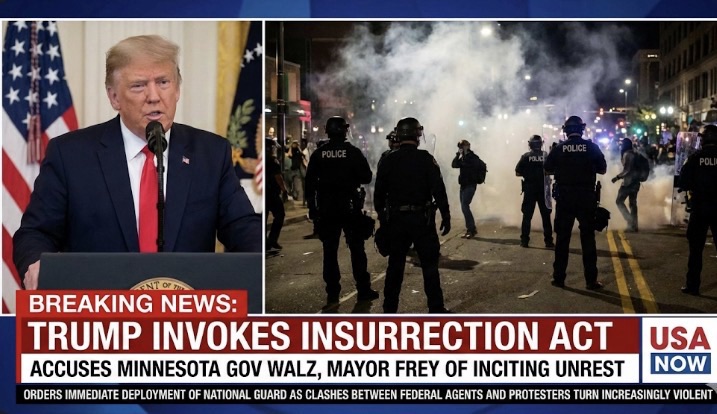
Trump Invokes Insurrection Act, Blames Minnesota Leadership for Escalating Unrest, Orders Immediate National Guard Deployment
In a dramatic escalation of political and security tensions, President Donald Trump on Tuesday announced that he had invoked the Insurrection Act, authorizing the immediate deployment of National Guard units to Minnesota. The President accused Governor Tim Walz and Minneapolis Mayor Jacob Frey of “inciting an insurrection” through what he described as a failure to control growing clashes between federal agents and protesters in the Twin Cities.
Speaking during a brief address from the White House, Trump characterized the unrest as “a coordinated assault on federal authority”, claiming that the situation had reached a point where normal law enforcement operations were no longer sufficient.
“This administration will not allow violent mobs to attack federal personnel or federal property,” Trump declared. “Governor Walz and Mayor Frey have abandoned their duties, fueling chaos and enabling insurrection. I am invoking the Insurrection Act to restore law and order in Minnesota immediately.”
Clashes Prompt Federal Action
For several consecutive nights, federal agents and demonstrators have engaged in increasingly intense confrontations in Minneapolis and St. Paul. Protests originally began over allegations of excessive force by federal personnel, but escalated into wider clashes after reports of injuries, detentions, and property damage surfaced.
Local authorities have struggled to de-escalate the situation, with police departments stretched thin and conflicting orders from state and federal officials generating confusion on the ground.
State Officials Deny Wrongdoing
In response to the President’s statement, both Governor Walz and Mayor Frey issued separate statements rejecting Trump’s accusations. Walz described the President’s remarks as “political theater designed to undermine state authority”, while Frey called the insurrection allegation “absurd and insulting to the people of Minnesota.”
Neither official accepted responsibility for the clashes, instead blaming federal intervention for fueling tensions.
“The presence of uncoordinated federal forces has escalated — not reduced — the violence in our city,” Frey stated. “Minnesota does not need martial law. What we need is cooperation and de-escalation.”
Deployment Already Underway
Within hours of the presidential address, National Guard vehicles were spotted departing nearby bases. Military officials confirmed that Guard units would support federal operations in Minneapolis, though their exact role remained unclear.
Under the Insurrection Act, the President can deploy military forces domestically under specific circumstances involving rebellion, violent obstruction of federal law, or breakdowns in state authority.
Legal scholars noted that invoking the Act is rare and historically controversial, due to the balance of power between state and federal governments. Congress has not yet commented on the President’s decision, but several prominent lawmakers from both parties signaled concern over the political implications.
Public Reaction Divided
Public response to the announcement was mixed. Supporters of the President argued that federal intervention was necessary to protect public safety and restore control, while critics accused Trump of overreach, claiming he was using military tools to pursue political disputes with Democratic state leaders.
Community organizers expressed fears that military deployment could increase tensions on the streets, while business owners in affected neighborhoods voiced hope that National Guard presence might stabilize the situation.
What Comes Next
With the National Guard now mobilized and political confrontation intensifying, Minnesota faces an uncertain immediate future. Whether the deployment will calm the situation or inflame it further remains to be seen.
For now, federal and state government officials remain at odds not only over how to end the violence, but over who is responsible for allowing it to escalate in the first place.

Taylor Swift Submits Formal Petition to Congress Calling for the Dissolution of ICE after House Passes Bill Authorizing $10B increase in ICE Funding, Citing Multiple Killing and Ongoing Violent Protest in Minnesota, Arguing ICE Has “Done More Harm Than Good” to Communities to be wasted money on

Donald Trump Activates the National Guard and Orders Rapid March Into Minnesota as ICE-Related Protests Intensify, Directing Commanders to Suppress Violent Conduct and ‘Shoot Down’ Hostility Toward Federal Officers

Taylor Swift Warn Donald Trump to Reconsider Threatening National Guard Deployment and Invoking the Insurrection Act in Minnesota, Says it could lead to War, Saying There Are Far Better Ways to Address the Escalating ICE-Related Protests

U.S. House and Senate Secure the Necessary Votes to Pass the Bipartisan NATO Unity Protection Act, Explicitly Blocking Donald Trump From Using Military Force to Seize Greenland, a Danish Territory Under NATO Protection

Supreme Court Block House Passage of Sweeping DHS Funding Bill, Declaring the $10 Billion ICE Expansion Unconstitutional After Democrats Crossed Party Lines to Deliver a 220-207 Victory Following Donald Trump’s involvement

Iran Government Condemns “Blatant U.S. Double Standards” After Border Patrol Shoots Minneapolis Protester, Citing Donald Trump’s Earlier Threat to Intervene Militarily Over Similar Protester Deaths in Iran

Donald Trump Invokes Insurrection Act, Accuses Minnesota Gov Tim Walz and Mayor Jacob Frey of Inciting Unrest, Orders Immediate Deployment of National Guard as Clashes Between Federal Agents and Protesters Turn Increasingly Violent

Donald Trump Orders Immediate Impeachment and Arrest of Gov. Tim Walz and Mayor Frey for Inciting Insurrection in Minnesota after attack allege Attack on Federal agents and ICE officers

President Donald Trump Reportedly Order ICE to Continue Detaining 2-Year-Old Girl Taken Into Custody in Minneapolis, Even After Supreme Court Orders Her Release

World Health Organization Files $1 Billion Legal Action at the International Court of Justice against Donald Trump and United States, Alleging Trump-Ordered U.S. Withdrawal from the Organization Violated International Health Agreements and Caused Major Economic Losses

California Governor Gavin Newsom Announces Historic Plan for the California to Join the World Health Organization, Directly Challenging the Federal Government and Donald Trump’s Decision to Withdraw the United States
