
NFL
Donald Trump Removes Navy Secretary John Phelan Amid Intensifying U.S. Naval Blockade and Rising Tensions after Iran Seize Multiple Ships Near the Hormuz Strait Due to The Navy refusing an attack order from Donald Trump

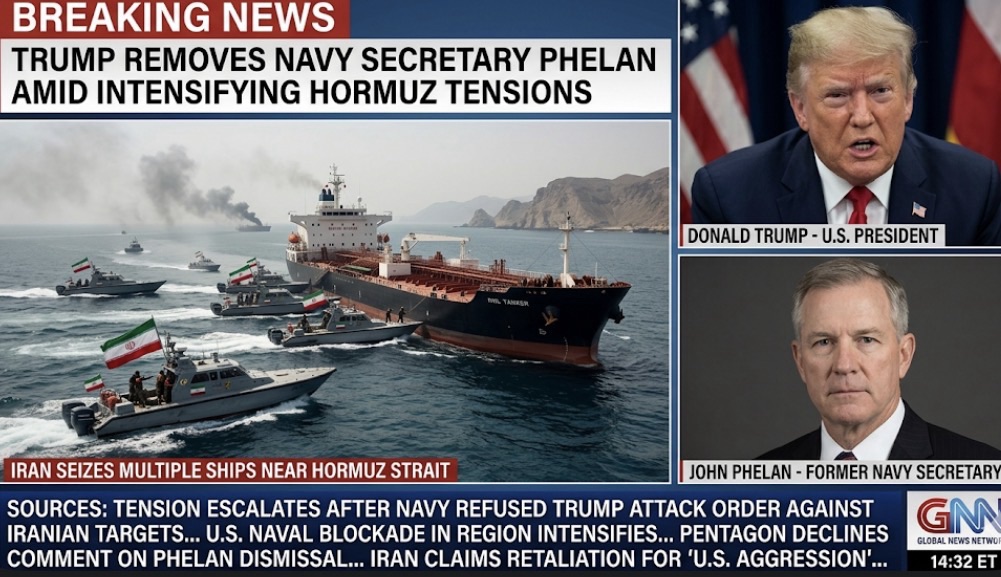
U.S. Navy Leadership Shaken as John Phelan Is Fired Amid Escalating Strait of Hormuz Crisis
Washington, D.C. — A sudden leadership shake-up inside the United States military has intensified concerns over a rapidly escalating confrontation in the Middle East, as John plan was removed from his position amid a high-stakes naval standoff with Iran.
The dismissal comes at a critical moment, with U.S. forces enforcing a strategic maritime blockade near the Strait of Hormuz —one of the world’s most vital oil transit routes—while Iranian forces have reportedly seized multiple vessels in defiance of American pressure.
Officials within the administration of Donald Trump have offered limited public explanation for Phelan’s removal, describing it only as part of a “necessary leadership transition” during a time of heightened operational demand. However, the timing of the decision has sparked intense speculation in Washington and among defense analysts, with many questioning whether internal disagreements over military strategy may have played a role.
The crisis in the Strait of Hormuz has been building for weeks, following a series of confrontations between U.S. naval forces and Iranian units. Tehran’s latest move—seizing commercial vessels believed to be linked to Western interests—has been widely interpreted as a direct challenge to the U.S. blockade and a signal that diplomatic channels are rapidly narrowing.
Security experts warn that the removal of a top Navy official during an active geopolitical flashpoint could introduce uncertainty into an already volatile situation. “Leadership continuity is critical in moments like this,” one former Pentagon official noted. “Any abrupt change raises questions about coordination, command, and the broader strategy moving forward.”
Despite rising tensions, there has been no official confirmation that Phelan’s dismissal was tied to any specific operational decision, including reported disagreements over potential military action against Iranian targets. The Pentagon has declined to comment on internal deliberations, emphasizing instead that U.S. forces remain “fully prepared and mission-capable.”
Meanwhile, global markets have begun reacting to the instability in the region. The Starit of hormuz handles a significant percentage of the world’s oil shipments, and any prolonged disruption could have far-reaching economic consequences.
As the situation continues to evolve, international observers are closely watching whether the leadership change signals a shift toward a more aggressive posture—or an attempt to reassert control amid growing uncertainty.
For now, the firing of John Phelan adds another layer of tension to a crisis that shows no clear signs of easing, with the risk of further escalation looming over one of the world’s most strategically important waterways.

Taylor Swift Links Up With Travis Kelce and Dakota Johnson After the 2026 VMAs as the Trio Pose Together Inside Taylor’s Private Jet Following Her Big Night

Travis Kelce Confirms VMAs Appearance to Support Wife Taylor Swift After Scoring Touchdown in Chiefs’ Miami Victory Over the Dolphins

The Swift-Kelce Family Is in Miami! Donna Kelce, Taylor Swift’s Mom Andrea and Brother Austin Arrive Ahead of Travis Kelce’s Chiefs Showdown Against the Dolphins

“Mr. Cleveland” Travis Kelce Touches Down in Miami With Patrick Mahomes and Chiefs Teammates Ahead of Sunday’s Dolphins Showdown

“Uncle Cleveland!” Jason and Kylie Kelce’s Daughters Wyatt and Elliotte React to Taylor Swift’s New Travis Kelce-Inspired Track as the Family Plays “Cleveland” Together

Taylor Swift and Travis Kelce’s Moms Andrea Swift and Donna Kelce Pose Alongside Caitlin Clark’s Grandfather, Father and Mother at Indiana Fever Game Against Minnesota Lynx.

Taylor Swift and Travis Kelce’s Moms Andrea Swift and Donna Kelce Make a Joint Appearance at Indiana Fever-Lynx Game as Caitlin Clark Greets Them Before the Match Begins

Taylor Swift Poses With Brittany Mahomes and Fellow Chiefs WAGs in Arrowhead Suite During Dramatic Game as Travis Kelce and Patrick Mahomes Help Kansas City Beat Colts 33-30

Taylor Swift Poses With Brittany Mahomes and Fellow Chiefs WAGs in Arrowhead Suite During Dramatic Game as Travis Kelce and Patrick Mahomes Help Kansas City Beat Colts 33-30

Taylor Swift Poses With Mother-in-Law Donna Kelce and Mom Andrea Swift at Arrowhead After Chiefs’ Dramatic Late Win Over Colts, Celebrating Travis Kelce’s Touchdown

Donna Kelce and Taylor Swift Share a Sweet Mother-in-Law Moment as they Spotted Deep in Conversation at Travis Kelce’s Newly Purchased Ohio Mansion as Family Dog Wendy Playfully Runs Around
