
NFL
Russia Moves Ahead with $10B Nuclear Investment in Iran as Tehran Rejects Donald Trump’s Deal as Vladimir Putin’s States they have Nuclear Rights

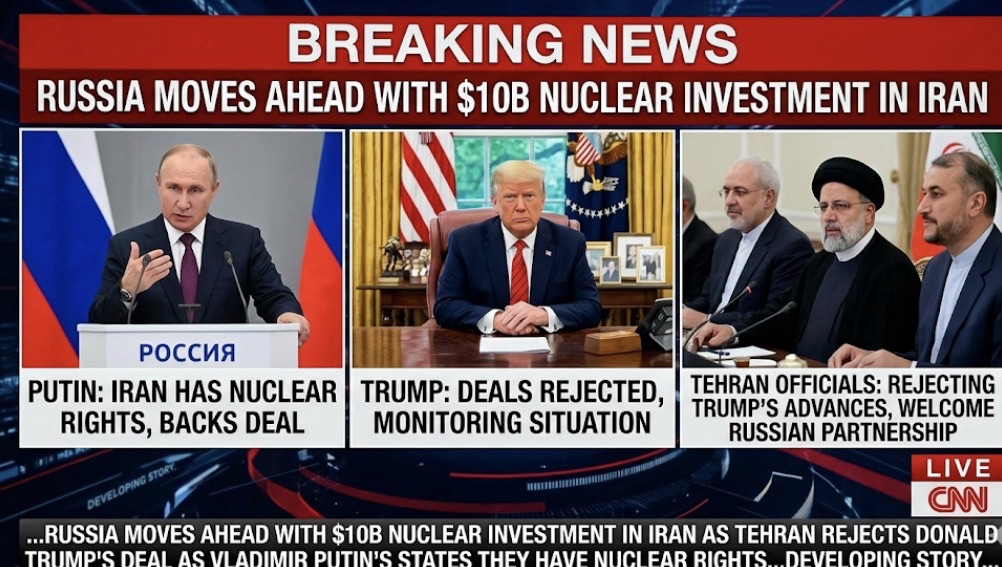
Russia Backs Iran’s Nuclear Rights as Putin Signals Support for Peaceful Program
Russia has reiterated its support for Iran’s right to own and operate a civilian nuclear program, with President Putin signaling that Tehran is entitled to develop nuclear energy for peaceful purposes despite ongoing tensions with the United States and its allies.
The statement comes at a time of renewed geopolitical strain following Iran’s rejection of a proposed nuclear framework associated with Trump, which sought to impose stricter limits on Tehran’s nuclear activities. Iranian officials have maintained that the country will not accept any agreement that undermines its sovereignty or restricts what it considers its legitimate rights under international law.
Moscow’s position places it firmly alongside Tehran on the issue of nuclear sovereignty, at least in principle. Russian officials have repeatedly emphasized that Iran, as a signatory to the Nuclear Non-Proliferation Treaty (NPT), has the legal right to pursue nuclear energy for civilian use, including power generation and scientific research.
However, Putin has also indicated that such support comes with expectations. The Kremlin continues to advocate for transparency and international oversight to ensure that Iran’s nuclear program remains strictly peaceful. Analysts note that Russia has historically supported limits on sensitive activities such as high-level uranium enrichment, reflecting a balancing act between strategic partnership and global non-proliferation concerns.
For Iran, the backing of Russia provides both political cover and technical partnership. The two countries have cooperated for years on nuclear energy projects, including reactor construction and fuel supply arrangements. Strengthening that relationship could help Tehran advance its domestic energy goals while resisting Western pressure.
The United States and several European powers, however, remain skeptical. Washington has long argued that Iran’s nuclear activities could be diverted toward military purposes, a claim Tehran consistently denies. The latest developments are likely to deepen divisions between global powers already at odds over security issues in the Middle East.
As diplomatic efforts continue to stall, Russia’s stance underscores a shifting global alignment in which major powers increasingly take divergent approaches to nuclear governance. Whether this support leads to renewed negotiations or further escalation remains uncertain, but it is clear that Iran’s nuclear ambitions will remain at the center of international debate for the foreseeable future.

Senate Democrats, Led by Elizabeth Warren, Strongly Oppose Republican-Backed Budget Bill That Seeks Taxpayers Billions More to Sustain Donald Trump’s Unauthorized Military Campaign in Iran and Ramp Up ICE Enforcement Operations

U.S. President Donald Trump Calls for America’s Shift Toward a One-Party System, Suggesting a National Convention to Introduce Constitutional Amendments Claiming Current System Is ‘Broken’ and Ruining America

Russia Moves Ahead with $10B Nuclear Investment in Iran as Tehran Rejects Donald Trump’s Deal as Vladimir Putin’s States they have Nuclear Rights

House Democrats Intensify Efforts to Draft Articles of Impeachment Against President Donald Trump, Citing Unauthorized and Unconstitutional Military Strikes Launching the Costly 2026 Iran War Without Congressional Approval and Many Other Atrocities Including Epstein File

Donald Trump Claims Significant Progress in Secret Talks with Iran Including Zero Enrichment and Uranium Handover and No Nuclear Weapons Which Iranian Officials Call It a Bluff and Fake Claims

Donald Trump Condemns Putin and Demands War Crimes Charges Following Large-Scale Russian Air Assault That Left Ukrainian Civilians Dead Overnight amid ongoing war in Iran

Iran Signals It Is Preparing to Lay Naval Mines in the Strait of Hormuz Following a new Messages from Donald Trump

Supreme Court of the United States Orders Immediate Withdrawal of ICE Agents From Airport Security Operations After Donald Trump Deploy ICE to Aid TSA Staffs Amid Ongoing DHS Funding Crisis

Taylor Swift Poses with Travis Kelce alongside Donna Kelce as Chiefs Star Signs On for 14th Season

NATO Forces Seize and Impound U.S. Aircraft Carrier The USS Gerald R. Ford Upon Returning From Iran to Souda Bay in Crete, Securing All Aircraft, Personnel, Ordnance, Fuel, and Defense Systems Following ICC Arrest Warrant For Donald Trump and Escalating Tension with NATO allies

Gavin Newsom Slam Donald Trump, Saying He Is “Making a Fool and Mockery of Himself” After Abruptly Pausing U.S. Military Strikes on Iran Just Hours After Issuing a 48-Hour Ultimatum to Reopen the Strait of Hormuz
